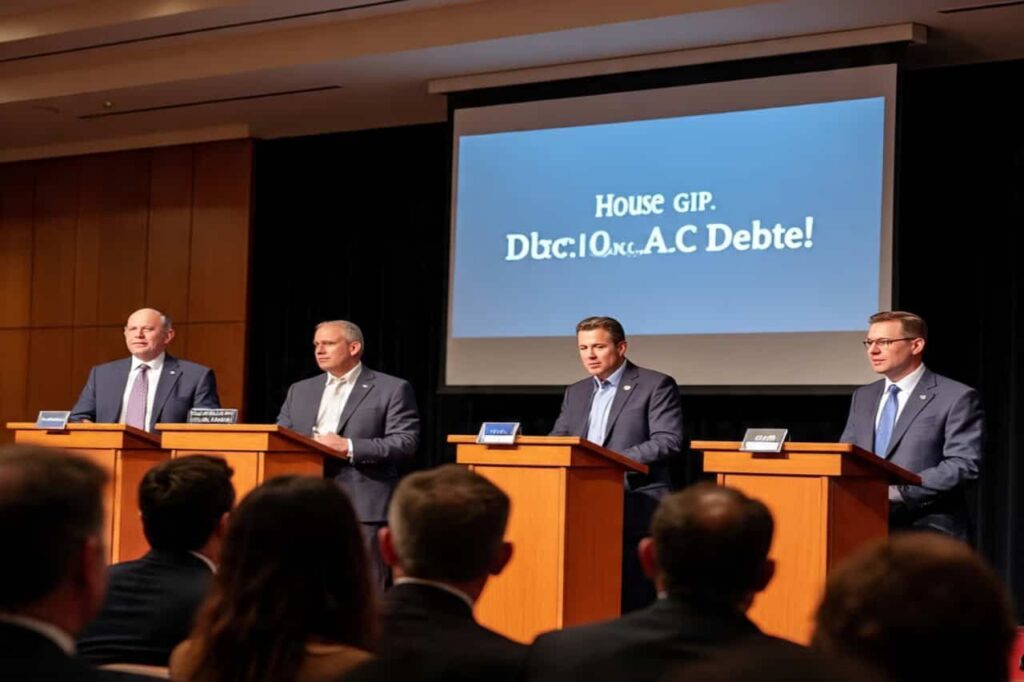
The political clash over Washington, D.C.’s governance is heating up again. This time, the spotlight is on the House GOP and its push to introduce new bills that could dramatically reshape the capital city’s justice system. Among the most controversial proposals is one that would strip power from Washington’s elected Attorney General (AG)—a move critics call an attack on local democracy.
For Republicans, these bills represent a chance to tighten control over crime and public safety in the nation’s capital. For Democrats and local leaders, it’s another example of federal overreach undermining D.C.’s right to self-govern. The fight over the House GOP D.C. AG issue is more than a local battle—it’s part of a broader struggle about power, justice, and representation in the United States.
Background: D.C.’s Unique Political Status
To understand the controversy, one has to look at the unusual position of Washington, D.C. Unlike states, the District of Columbia does not enjoy full self-governance. While it has a mayor, a council, and since 2014, an elected attorney general, Congress holds ultimate authority over its laws and budget.
This means that even when D.C. voters choose their leaders and policies, Congress can override their decisions. That dynamic has long been a source of tension, especially when partisan politics enter the picture. The House GOP D.C. AG bills are the latest example of this struggle.
What the House GOP Is Proposing
The new Republican-led legislation targets two main areas:
- Removing the Elected Attorney General:
Republicans argue that the D.C. attorney general, currently an elected office, has taken on too much authority over public safety matters. By eliminating the position—or shifting it back under congressional or mayoral control—they hope to centralize decision-making. - Overhauling Justice Policies:
The second set of proposals focuses on crime laws. GOP lawmakers claim that D.C.’s progressive reforms, such as changes to sentencing guidelines and juvenile justice policies, have weakened accountability and emboldened criminals. Their plan seeks to roll back these reforms and enforce stricter laws.
Together, these proposals form the core of the House GOP D.C. AG fight—a bid to reset Washington’s justice system in a way that reflects Republican priorities rather than local preferences.
Why Republicans Say It’s Necessary
House Republicans argue that the proposals are about restoring law and order in the capital. They point to rising concerns about violent crime, carjackings, and repeat offenders. According to their view:
- The elected D.C. attorney general has prioritized reforms over safety.
- Residents and visitors to the capital deserve stronger protections.
- As the seat of the federal government, D.C.’s policies reflect on the entire nation.
In short, Republicans insist that Congress has both the right and the responsibility to step in when they believe local leaders are failing.
The Pushback: “An Attack on Democracy”
Critics of the bills—including Democrats, local activists, and even some nonpartisan experts—see things very differently. To them, the House GOP D.C. AG plan is not about safety but about stripping Washingtonians of their democratic rights.
Their arguments include:
- Local Choice Matters: D.C. residents voted to have an elected attorney general, and Congress overturning that vote ignores the will of the people.
- Overreach by Congress: Critics argue Republicans are exploiting D.C.’s unique status to advance political goals they could not push through in other cities.
- False Narrative on Crime: While crime is a concern, opponents say Republicans exaggerate the problem for political gain.
D.C. officials have repeatedly emphasized that local reforms are aimed at long-term community safety and fairness in the justice system—not leniency.
Why the Attorney General Role Matters
The position of D.C. attorney general has become increasingly influential in shaping justice policy. The office prosecutes juvenile cases, enforces civil laws, and advocates for public safety reforms. In recent years, it has clashed with federal authorities and even the mayor over approaches to crime.
That independence is exactly why Republicans want to curb its power. But for D.C. voters, it represents one of the few elected positions where their voices can directly shape local justice policy. Removing or weakening it could reduce their already limited political representation.
The Bigger Picture: Crime, Politics, and Statehood
The battle over the House GOP D.C. AG bills cannot be separated from larger debates about D.C. statehood and representation. Washington, D.C. has over 700,000 residents—more than some states—yet they have no voting representation in Congress.
For decades, statehood advocates have argued that D.C. should be treated like a state, free from congressional micromanagement. Republican opposition to that idea has only deepened the divide. The current bills, therefore, are seen not just as policy changes but as a symbolic rejection of D.C.’s autonomy.
Public Opinion
Among D.C. residents, the proposals are largely unpopular. Many feel frustrated that outsiders—lawmakers who don’t live in the city—are trying to dictate their local governance.
Outside the district, however, views are mixed. Some Americans sympathize with calls for stricter law enforcement in the capital. Others believe that D.C. should be free to govern itself like any other city.
This divide highlights the difficulty of balancing national interests with local democracy.
Potential Consequences
If the House GOP succeeds in passing these bills, the impact could be wide-ranging:
- Loss of Local Control: D.C. residents would no longer elect their attorney general.
- Tougher Justice Policies: Sentencing could become stricter, and juvenile offenders could face harsher penalties.
- Precedent for More Interventions: Congress could be emboldened to interfere further in D.C. policies, from housing to education.
On the other hand, if the bills fail, Republicans may still succeed in keeping crime and safety at the center of national debate—a theme they believe will resonate with voters heading into elections.
FAQs – House GOP D.C. AG Debate
Q1. What is the House GOP D.C. AG proposal?
It’s a set of bills that would remove Washington’s elected attorney general and overhaul local justice policies.
Q2. Why do Republicans support it?
They argue it’s necessary to combat crime and restore public safety in the nation’s capital.
Q3. Why are critics opposed?
They see it as federal overreach and an attack on D.C. residents’ democratic rights.
Q4. What power does the D.C. attorney general have?
The AG oversees juvenile prosecutions, civil law enforcement, and justice reform policies.
Q5. When was the D.C. AG made an elected position?
In 2014, following a voter referendum.
Q6. How does crime in D.C. compare nationally?
While certain crimes have risen, critics argue Republicans exaggerate the issue for political purposes.
Q7. Can Congress legally remove the AG?
Yes, because the Constitution gives Congress authority over D.C.
Q8. Do D.C. residents have a say in this decision?
Not directly—Congress has the final authority.
Q9. How does this connect to D.C. statehood?
The bills highlight how limited D.C.’s autonomy is without statehood.
Q10. Who currently holds the office of D.C. AG?
(Insert current AG name depending on year; for 2025 it is Brian Schwalb.)
Q11. What reforms has the D.C. AG supported?
Juvenile justice reforms, civil rights protections, and community safety programs.
Q12. What happens if the bills pass?
The AG role could be eliminated, and harsher justice laws imposed.
Q13. Do Democrats support these bills?
No, most Democrats strongly oppose them.
Q14. How does public opinion in D.C. lean?
The majority oppose federal interference and support keeping the AG elected.
Q15. Is this likely to pass?
Passage depends on Senate dynamics and presidential approval, so the outcome is uncertain.