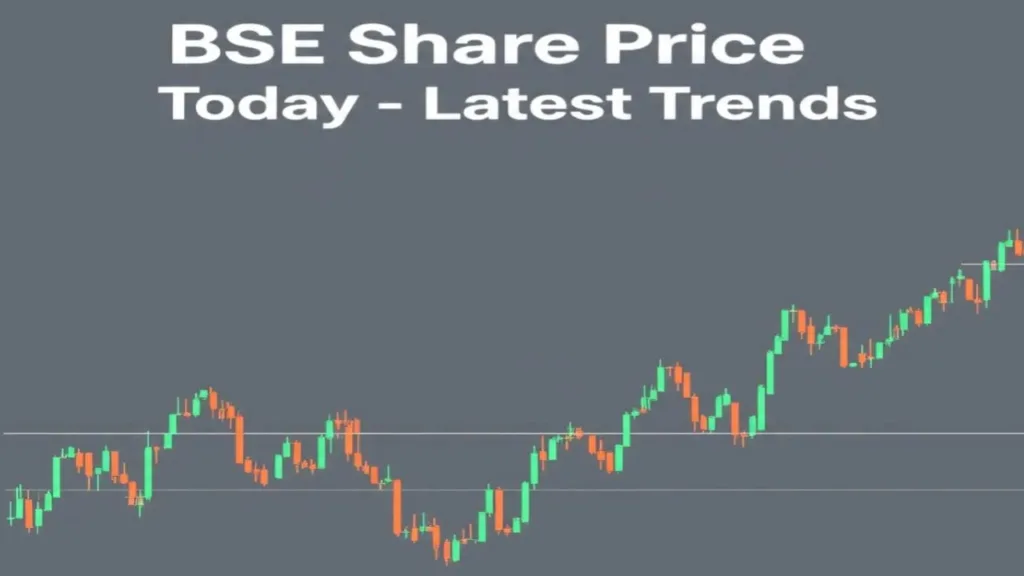
The BSE share price has been one of the most discussed topics in the Indian stock market lately. Investors, traders, and analysts are keeping a close watch on the movements of BSE Ltd., the parent company of Asia’s oldest stock exchange – the Bombay Stock Exchange. Over the past few months, the BSE share price has seen significant fluctuations, hitting all-time highs and facing sharp declines in response to regulatory developments and market dynamics.
In this article, we will explore the latest updates on the BSE share price, historical performance, reasons behind recent volatility, long-term growth potential, and what experts are predicting for the future.
Current BSE Share Price – August 2025 Update
As of August 21, 2025, the BSE share price was trading around ₹2,332.20 on the NSE. This marks a sharp drop of nearly 7.7% in a single trading session. The fall came after remarks by SEBI Chairperson about extending equity derivative contract tenures – a regulatory move that created concerns among market participants.
Despite the sudden correction, the BSE share price remains one of the top-performing stocks of 2025, with strong returns over the past year. Earlier in June 2025, BSE Ltd. had touched an all-time high of ₹3,030, giving investors impressive gains.
Why Did the BSE Share Price Drop Recently?
The sudden fall in the BSE share price was triggered by regulatory comments. The SEBI chief proposed changes in equity derivative contract maturities, suggesting longer tenures. This announcement unsettled market participants, especially brokers and exchanges like BSE, since it could impact trading volumes and liquidity in derivatives.
For companies like BSE Ltd., derivatives trading contributes significantly to revenues. Any change in contract structures could impact short-term income, which is why the BSE share price reacted negatively.
However, many analysts believe that such regulatory changes, if implemented carefully, will not harm exchanges in the long run. On the contrary, longer-tenure contracts could attract new types of institutional investors.
BSE Share Price – Key Financials and Valuation
Before analyzing the future, let’s look at some important valuation metrics:
- Market Capitalization: Around ₹94,717 crore
- 52-Week High: ₹3,030 (touched in June 2025)
- 52-Week Low: ₹894
- P/E Ratio (TTM): ~59x–60x
- Book Value: Approx. ₹109 per share
- Dividend Yield: Around 0.30%
These numbers show that the BSE share price has multiplied significantly from its 52-week low, rewarding long-term investors. The relatively high P/E ratio suggests the stock is priced for strong future growth.
Historical Journey of BSE Share Price
The journey of the BSE share price reflects the evolution of Indian financial markets. For years, the Bombay Stock Exchange was seen as a conservative, slow-moving stock compared to NSE. But in the past three years, BSE Ltd. has reinvented itself with strong growth in equity derivatives, mutual fund platforms, and digital services.
- In 2020–21, the BSE share price was trading below ₹600.
- By mid-2023, it crossed ₹1,000 as trading volumes surged.
- In 2024, the stock started drawing serious investor interest, jumping past ₹2,000.
- In June 2025, it touched ₹3,030 – its all-time high.
For early investors, the rise of the BSE share price has been nothing short of remarkable.
Factors Driving the Growth of BSE Share Price
Several factors have contributed to the rise of the BSE share price in recent years:
- Surge in Equity Derivatives Trading – BSE has significantly increased its market share in derivatives, competing with NSE.
- Technology Upgrades – Faster settlement systems and robust trading platforms have attracted more traders.
- Mutual Fund Distribution Platform (StAR MF) – BSE’s digital platform has become the largest in India for mutual fund transactions, boosting revenues.
- IPO Market Boom – India’s IPO wave over the last two years has increased listing revenues for BSE.
- Investor Optimism – Retail investors have shown strong confidence in Indian exchanges as businesses.
All these drivers have contributed to the bullish trend in the BSE share price.
Risks to BSE Share Price
While the outlook remains positive, investors must also consider risks:
- Regulatory Uncertainty – As seen recently, SEBI’s policies can impact the exchange business.
- Competition with NSE – NSE remains India’s dominant exchange. Any aggressive pricing or product innovation from NSE could pressure BSE.
- Market Volatility – The BSE share price is directly linked to trading volumes. A slowdown in the market could impact revenues.
- Global Market Trends – International economic factors, such as US interest rates and global liquidity, affect Indian markets and, in turn, exchange revenues.
BSE Share Price Compared to NSE (Unlisted)
Unlike BSE, NSE is not listed yet, but its IPO is one of the most anticipated in India. Many investors view BSE share price as a proxy to bet on the Indian exchange business. Since NSE dominates the derivatives segment, BSE’s strong growth has surprised many.
If NSE lists in the future, comparisons will intensify. For now, the BSE share price enjoys the spotlight as the only listed stock exchange in India.
Expert Views on BSE Share Price
Market experts have mixed but mostly positive opinions:
- Bullish View: Many analysts believe that despite short-term volatility, the BSE share price has the potential to cross ₹3,500–₹4,000 in the next year if trading volumes continue rising.
- Neutral View: Some caution that the current valuations (high P/E) already factor in a lot of growth. Investors should wait for dips before buying.
- Bearish View: A minority warn that heavy reliance on derivatives could be risky if regulatory restrictions increase.
Long-Term Potential of BSE Share Price
The long-term potential of the BSE share price remains strong. With India’s capital markets expanding, retail investor participation growing, and IPO pipelines full, exchanges like BSE are positioned for sustainable growth.
Digital transformation is another key driver. BSE’s tech-driven platforms for mutual funds, bonds, insurance, and commodities make it a diversified play in India’s financial services ecosystem.
Investor Strategies for BSE Share Price
If you are an investor considering BSE share price, here are some strategies:
- Long-Term Investors: Treat BSE as a long-term compounder. Buy on dips and hold for 5–10 years to benefit from India’s growing financial market.
- Traders: The stock is volatile; short-term traders can benefit from swings between ₹2,200–₹3,000.
- Value Seekers: Compare BSE’s valuations with global exchanges (like NASDAQ or LSE). If valuations stretch too high, wait for corrections.
BSE Share Price and India’s Financial Growth
It is important to note that the performance of BSE share price is closely tied to India’s economic story. As the Indian economy continues to grow at one of the fastest rates globally, more companies will list on exchanges, more investors will participate, and more products will be traded.
BSE, being at the heart of this ecosystem, will naturally benefit. Thus, the BSE share price is not just about company performance but also about India’s financial growth trajectory.
Conclusion – What to Expect Next?
The BSE share price may have corrected recently, but the long-term story remains intact. Investors should not be overly worried about short-term regulatory-driven volatility. Instead, they should focus on the bigger picture – BSE’s strong fundamentals, rising market share, and India’s booming capital market.
With a 52-week range of ₹894–₹3,030, the stock has already proved its potential to deliver massive returns. As markets mature, the BSE share price could continue to climb, making it one of the most exciting stocks to watch in India.
For those who believe in India’s growth story, the BSE share price represents a unique opportunity to invest in the backbone of the country’s financial markets.
15 Searchable FAQs (SEO Optimized)
Q1. What is the current BSE share price?
The current BSE share price is around ₹2,332 as of August 21, 2025.
Q2. Why did the BSE share price fall recently?
The BSE share price dropped 7–8% after SEBI proposed longer equity derivative tenures, raising concerns about trading volumes.
Q3. What is the 52-week high and low of BSE share price?
The 52-week high is ₹3,030, while the low is ₹894.
Q4. What is the market cap of BSE Ltd?
BSE Ltd. has a market capitalization of around ₹94,717 crore.
Q5. Is BSE share price a good investment in 2025?
Yes, analysts consider BSE a strong long-term play on India’s growing financial markets, despite short-term volatility.
Q6. What is the P/E ratio of BSE share price?
The BSE stock trades at a P/E ratio of around 59–60x, indicating high growth expectations.
Q7. How has BSE share price performed historically?
The BSE share price has surged from under ₹600 in 2020 to over ₹3,000 in 2025, offering multi-bagger returns.
Q8. What factors drive the BSE share price?
Key drivers include growth in derivatives trading, IPO listings, mutual fund transactions, and rising retail participation.
Q9. What risks affect the BSE share price?
Risks include regulatory changes, competition from NSE, and market slowdowns affecting trading volumes.
Q10. Does BSE Ltd. pay dividends?
Yes, BSE pays dividends, with a dividend yield of around 0.30% in 2025.
Q11. What is the long-term outlook for BSE share price?
The long-term outlook is positive, with experts projecting targets of ₹3,500–₹4,000 in the next year.
Q12. How is BSE share price linked to India’s economy?
BSE share price is closely tied to India’s capital market growth, IPO pipeline, and retail investor participation.
Q13. Is BSE share price better than NSE?
Currently, NSE is unlisted, so investors prefer BSE as the only listed stock exchange in India.
Q14. What is the book value of BSE share?
The book value of BSE shares is around ₹109 per share.
Q15. How can I invest in BSE share price?
Investors can buy BSE shares through NSE/BSE trading platforms via any registered stockbroker.
Read More :- Titan Share Price Drops Over 6% – Should You Buy the Dip or Wait?