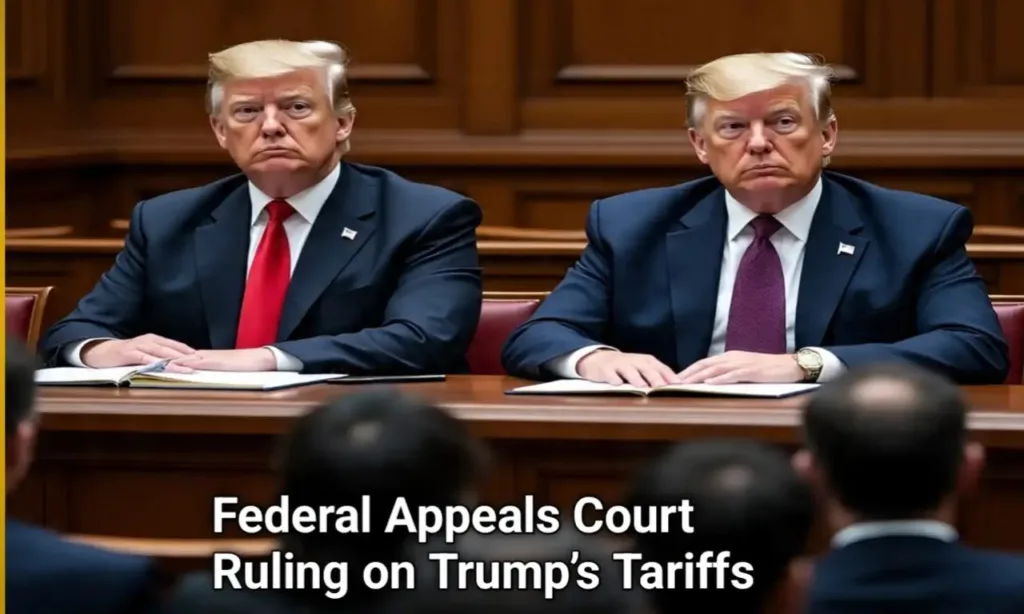
The recent decision by a federal appeals court on former U.S. President Donald Trump’s use of emergency powers to impose tariffs has stirred widespread debate across the political and economic spectrum. This ruling directly challenges the balance of power between the executive and legislative branches of the U.S. government, while also highlighting the far-reaching impact of tariffs on businesses, consumers, and international trade relations. In this article, we will break down the court’s decision, its implications, and what lies ahead for America’s trade policies.
Background of Trump’s Tariff Strategy
During his presidency, Donald Trump used tariffs as a key tool of his economic and trade strategy. He imposed duties on imports from major trading partners like China, Canada, Mexico, the European Union, Japan, Brazil, and India. The aim was to reduce trade deficits, revive domestic manufacturing, and force foreign nations to negotiate more favorable deals with the United States.
To justify these tariffs, Trump frequently invoked the International Emergency Economic Powers Act (IEEPA) of 1977, arguing that foreign trade imbalances and unfair practices posed an “extraordinary threat” to U.S. national security and the economy. However, critics argued that the law was never intended to give presidents unlimited authority to impose across-the-board tariffs.
The Appeals Court Ruling
On Friday, a federal appeals court declared that Trump had misused his authority under the IEEPA. The panel of seven judges clearly stated that the power to impose tariffs lies exclusively with Congress, as outlined in the U.S. Constitution.
“Tariffs are a core Congressional power,” the ruling emphasized.
Despite this, the court allowed the tariffs to remain in place temporarily while the case continues, creating uncertainty for businesses and markets.
This ruling underscores an important constitutional principle: Congress alone has the authority to impose taxes, including tariffs. The court effectively challenged Trump’s expansive interpretation of executive powers.
Businesses Caught in Uncertainty
The unpredictable nature of tariff policies under Trump created chaos for businesses. Companies like V.O.S. Selections Inc. (a wine and spirits importer) and Plastic Services and Products (a pipe and fittings company) even filed lawsuits against the administration.
The National Retail Federation (NRF) also expressed frustration, noting that retailers typically plan inventories six to nine months in advance. Constantly shifting tariff rules made it nearly impossible to forecast costs, manage supply chains, and place orders with confidence.
Court of International Trade’s Initial Decision
Earlier in May, the Court of International Trade had already blocked the tariffs under IEEPA, pointing out:
- The law does not grant unlimited tariff powers to the president.
- The tariffs failed to meet the requirement of addressing an “unusual and extraordinary” national threat.
This earlier decision laid the groundwork for the appeals court ruling, strengthening the argument that Trump had exceeded his constitutional authority.
Trump’s Defense of Tariffs
Trump has consistently defended tariffs as a way to generate revenue and restore balance to global trade. He claimed tariffs had brought in at least $125 billion in revenue, with promises of more through foreign investments.
However, many economists argue that tariffs have:
- Slowed global economic growth
- Increased inflation in the U.S.
- Hurt consumers by raising prices on goods
Instead of revitalizing U.S. manufacturing, the tariffs often led to higher costs for American companies and strained relations with key allies.
Alternatives Still Available
Even though the court limited the use of IEEPA, Trump—and future presidents—still have other legal pathways to impose tariffs, including:
- Section 301 of the 1974 Trade Act – allows tariffs after investigations into unfair trade practices.
- Section 232 of the 1962 Trade Expansion Act – permits tariffs for national security reasons (used for steel and aluminum duties).
- Section 338 of the 1930 Trade Act – allows up to 50% tariffs on imports from certain nations.
This means tariff battles are far from over, even if the IEEPA pathway is ultimately blocked.
Impact on International Relations
Trump’s tariffs reshaped global trade dynamics. Countries like China, the EU, and Canada retaliated with their own tariffs, sparking trade wars. Allies criticized the U.S. for undermining the rules-based international order.
For example:
- China imposed counter-tariffs on American agricultural products.
- The EU threatened new tariffs on American technology and cars.
- Canada retaliated with duties on U.S. steel and aluminum.
The ongoing uncertainty has also weighed heavily on stock markets, with businesses and investors unable to predict long-term trade policies.
Political Implications
The appeals court ruling could also set the stage for a major Supreme Court showdown. With six conservative justices—three appointed by Trump—the outcome remains uncertain. The ruling will also become a hot-button political issue, as debates over executive vs. congressional power intensify.
If the Supreme Court upholds the appeals court decision, it could limit presidential powers significantly in matters of trade. On the other hand, if the ruling is overturned, future presidents may have a free hand to use emergency powers for broad economic measures.
Conclusion
The federal appeals court ruling against Trump’s tariffs is more than just a legal setback—it is a defining moment in the battle over constitutional authority, trade policy, and the future of U.S. economic leadership. While tariffs remain in place for now, businesses, consumers, and international partners are bracing for continued uncertainty.
Whether the Supreme Court sides with Congress or the President will have long-lasting implications, not only for Trump’s legacy but also for America’s role in global trade.
🔹 10 FAQs on Trump Tariffs Court Ruling
Q1. What did the federal appeals court rule about Trump’s tariffs?
The court ruled that Trump misused his authority under IEEPA, stating that only Congress can impose tariffs.
Q2. Are Trump’s tariffs still in place?
Yes, the tariffs remain in place temporarily while the case continues.
Q3. Why did businesses oppose Trump’s tariffs?
Businesses argued that unpredictable tariffs made it difficult to plan inventory, costs, and supply chains.
Q4. What law did Trump use to impose tariffs?
He used the International Emergency Economic Powers Act (IEEPA) of 1977.
Q5. How much revenue did Trump claim tariffs generated?
Trump claimed tariffs generated at least $125 billion in revenue.
Q6. Did tariffs reduce America’s trade deficit?
Economists argue they had limited impact on reducing trade deficits and instead raised consumer prices.
Q7. Which trading partners were most affected by Trump’s tariffs?
China, Canada, Mexico, the European Union, India, Japan, and Brazil were among the hardest hit.
Q8. Can future presidents still impose tariffs without Congress?
Yes, they can use other trade laws like Section 301, Section 232, and Section 338.
Q9. What is the next step in the legal process?
The administration is expected to appeal to the U.S. Supreme Court.
Q10. How do tariffs affect ordinary consumers?
Tariffs typically raise prices on imported goods, leading to higher costs for consumers.