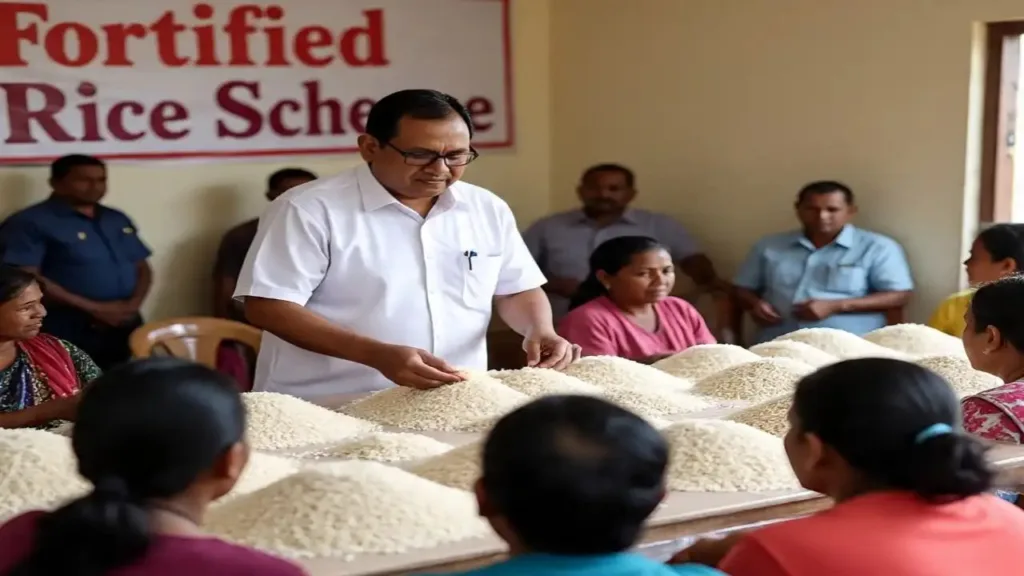
India has taken another big step toward improving public health and nutrition. The government recently announced the extension of its Fortified Rice Scheme until March 2028, backed by a massive investment of ₹17,082 crore (around $2 billion USD). This initiative aims to address two of the country’s most pressing health challenges—anaemia and malnutrition—by distributing fortified rice through major food and nutrition programs, including the Targeted Public Distribution System (TPDS), Integrated Child Development Services (ICDS), and the PM POSHAN program (formerly known as the mid-day meal scheme).
The move reflects India’s long-term commitment to improving nutritional security, especially among vulnerable populations such as women, children, and low-income households.
What is the Fortified Rice Scheme?
Fortified rice is regular rice that has been enhanced with essential micronutrients such as iron, folic acid, and vitamin B12. These nutrients are critical in fighting anaemia and improving overall nutrition levels, particularly in children and women of reproductive age.
The Fortified Rice Scheme was first introduced in 2019–20 as a pilot project. In 2021, Prime Minister Narendra Modi announced the government’s goal to provide fortified rice across all public food programs by 2024. The extension to 2028 ensures that the initiative has enough time, funding, and infrastructure to achieve nationwide coverage while addressing implementation challenges.
Why Fortified Rice?
Anaemia and malnutrition remain serious public health issues in India:
- Anaemia prevalence: According to the National Family Health Survey (NFHS-5), nearly 57% of women aged 15–49 years and more than 67% of children under 5 years suffer from anaemia.
- Malnutrition impact: Malnutrition contributes to stunted growth, weakened immunity, poor cognitive development in children, and higher maternal mortality rates.
Rice is a staple food for over 65% of India’s population, making it the most effective vehicle for delivering essential micronutrients to millions of households. By fortifying rice distributed under government schemes, India can tackle hidden hunger without requiring people to change their diets or cooking habits.
Government Funding and Scale
The extended program comes with ₹17,082 crore in funding, allocated to cover the cost of fortification, supply chain logistics, quality testing, and distribution.
Here’s how the scheme will be implemented:
- Production of Fortified Rice Kernels (FRKs): Special fortified kernels containing micronutrients will be blended with regular rice at a ratio of 1:100.
- Distribution through Public Systems: Fortified rice will be supplied via the Public Distribution System (PDS), PM POSHAN scheme, and ICDS program to reach schoolchildren, pregnant women, lactating mothers, and low-income families.
- Monitoring and Quality Assurance: The Food Corporation of India (FCI) and state governments will oversee strict quality checks to ensure that fortified rice is safe, effective, and accepted by communities.

Key Beneficiaries
The extension of the scheme will directly benefit millions of people across India. The main groups include:
- Schoolchildren receiving mid-day meals through the PM POSHAN program.
- Pregnant and lactating mothers through ICDS Anganwadi centers.
- Low-income families who access subsidized rice through the Public Distribution System (PDS).
- Adolescents and women, who are most vulnerable to anaemia and nutritional deficiencies.
By 2028, the government aims for 100% coverage across all districts of India.
Progress So Far
India has made significant strides since launching the fortified rice initiative:
- Pilot phase (2019–2021): Launched in 15 districts across the country.
- Expansion (2021–2024): Gradual rollout across states through PDS and school meal programs.
- Current status: As of 2024, fortified rice is being distributed in over 260 districts, covering millions of beneficiaries.
The extension will give states more time to build fortification plants, train staff, and strengthen supply chains.
Challenges in Implementation
While the scheme is ambitious, it faces several challenges:
- Awareness and Acceptance: Some communities are unfamiliar with fortified rice and may be hesitant to adopt it due to misconceptions about taste, appearance, or safety.
- Supply Chain Issues: Ensuring uniform blending of fortified kernels across thousands of rice mills is logistically complex.
- Cost of Production: Fortification adds to the cost of rice processing, though the government funding is designed to offset this.
- Monitoring Quality: Strict quality standards are needed to ensure that fortified rice consistently delivers the intended nutritional benefits.
To address these challenges, the government has launched awareness campaigns and partnered with local NGOs to build trust in fortified rice.
Broader Impact on Nutrition and Health
The Fortified Rice Scheme is expected to:
- Reduce anaemia rates among women and children.
- Improve school attendance and learning outcomes by boosting children’s energy and concentration.
- Lower maternal mortality rates by ensuring better health during pregnancy.
- Strengthen immunity and overall health in vulnerable populations.
This aligns with India’s broader goals under the Poshan Abhiyaan (National Nutrition Mission), which aims to improve nutrition outcomes by 2025.
International Recognition
Food fortification is not unique to India. Many countries, including the United States, Canada, and several African nations, have long used fortified staples like flour, milk, and salt to tackle hidden hunger. India’s large-scale push for fortified rice has been recognized by global organizations like the World Health Organization (WHO) and the World Food Programme (WFP) as a model for other developing nations.
Political and Social Significance
The extension of the scheme also reflects the government’s political commitment to social welfare and health security. By investing in nutrition, India is addressing one of the root causes of poverty and inequality—poor health and productivity caused by malnutrition.
This initiative could also strengthen India’s position as a leader in tackling global nutrition challenges.
Voices from the Ground
- Health experts have welcomed the move, noting that fortified rice can be a game-changer if backed by effective awareness campaigns and proper monitoring.
- Teachers and community workers have observed improved attentiveness among children in areas where fortified rice has already been introduced.
- Beneficiaries in pilot districts have reported no noticeable change in taste or cooking quality, which has helped build trust in the initiative.
Looking Ahead
With the extension to 2028, India has set a clear path forward:
- Expand fortified rice coverage to all districts.
- Strengthen monitoring and evaluation systems.
- Increase public awareness campaigns to ensure widespread acceptance.
- Collaborate with private sector and NGOs for effective implementation.
The ₹17,082 crore investment underscores the seriousness of the government’s commitment. If executed effectively, the scheme could transform India’s nutritional landscape and serve as a model for other developing nations battling malnutrition.
Conclusion
The extension of the Fortified Rice Scheme to 2028 is more than just a health initiative—it is an investment in India’s future. By addressing anaemia and malnutrition, the government is ensuring healthier mothers, stronger children, and a more productive workforce.
This program has the potential to change millions of lives, particularly among the most vulnerable populations. With adequate funding, strong political will, and robust implementation, India could be on the verge of a major public health breakthrough.
The next four years will be crucial in determining whether the scheme achieves its ambitious goals, but the direction is clear: India is committed to ending hidden hunger and building a healthier nation.
FAQs.
Q1. What is the Fortified Rice Scheme?
The Fortified Rice Scheme is a government initiative to add essential nutrients like iron, folic acid, and vitamin B12 to rice, helping combat anaemia and malnutrition across India.
Q2. Why was the Fortified Rice Scheme extended to 2028?
The scheme was extended to ensure wider coverage and continued support for nutrition programs, addressing anaemia and malnutrition that still affect millions of people in India.
Q3. How much funding has been allocated to the Fortified Rice Scheme?
The Government of India has allocated ₹17,082 crore for the extended period until 2028 to strengthen the implementation of fortified rice distribution.
Q4. Which programs distribute fortified rice under the Fortified Rice Scheme?
Fortified rice is distributed under PM POSHAN (Mid-Day Meal Scheme), Integrated Child Development Services (ICDS), and Pradhan Mantri Garib Kalyan Anna Yojana (PMGKAY).
Q5. What are the benefits of the Fortified Rice Scheme?
It helps reduce iron-deficiency anaemia, improves nutritional intake, supports child growth, enhances women’s health, and strengthens food security programs.
Q6. Who benefits from the Fortified Rice Scheme?
Beneficiaries include school children under PM POSHAN, pregnant and lactating mothers under ICDS, and poor households receiving subsidized rice under NFSA and PMGKAY.
Q7. How does fortified rice help fight anaemia?
Fortified rice contains iron, folic acid, and vitamin B12, which are essential nutrients to prevent iron-deficiency anaemia and promote better health.
Q8. Which ministries are involved in the Fortified Rice Scheme?
The Ministry of Consumer Affairs, Food and Public Distribution, and the Ministry of Women and Child Development play a key role in implementing the scheme.
Q9. How much fortified rice is targeted to be distributed annually?
The scheme aims to cover over 80 crore beneficiaries under the Public Distribution System and nutrition-based programs by 2028.
Q10. Is fortified rice safe to consume?
Yes, fortified rice is completely safe. It maintains the same taste, texture, and cooking process as regular rice but includes added nutrients for better health.
Read More:-Viksit Bharat 2047: India’s Roadmap to a Developed Nation