Introduction
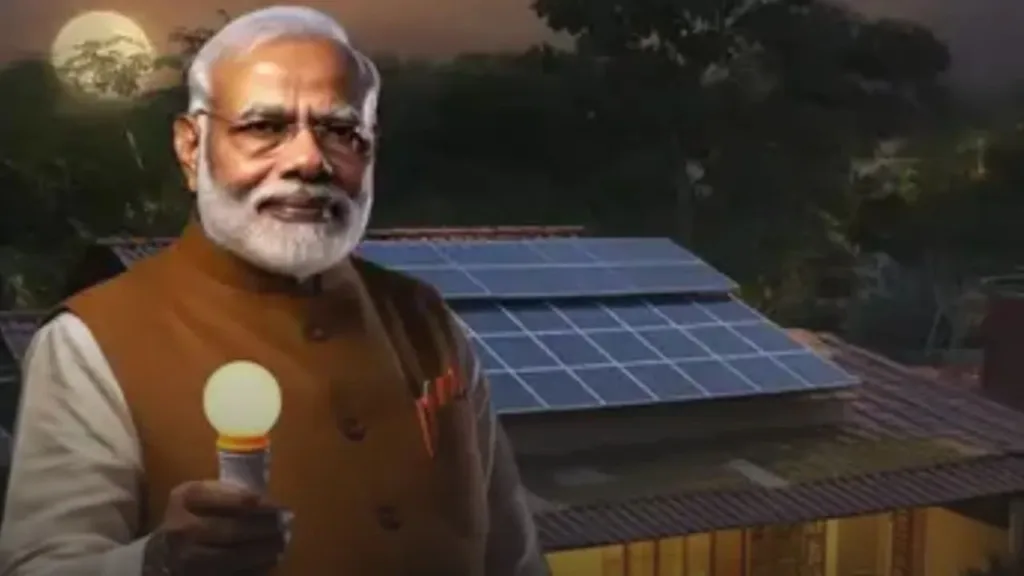
India is rapidly moving towards becoming a global leader in renewable energy, and one of the most revolutionary steps taken by the government is the launch of the PM Surya Ghar Muft Bijli Yojana 2025. This scheme is designed to promote solar rooftop electricity generation in households, making clean and free electricity a reality for millions of families. Under this initiative, the government will provide subsidies and financial support to encourage citizens to install solar rooftop panels, reducing dependency on costly electricity and supporting India’s mission for “Green Energy and Self-Reliance”.
The scheme was officially announced by Prime Minister Narendra Modi in early 2025 with a vision to provide free electricity up to 300 units per month to eligible households. It is not just about reducing electricity bills but also about promoting sustainable energy and making India less dependent on fossil fuels.
Key Objectives of PM Surya Ghar Muft Bijli Yojana 2025
The primary goals of this scheme include:
- Providing Free Electricity – Households installing rooftop solar panels can get up to 300 units of free electricity per month.
- Promoting Green Energy – To reduce pollution and reliance on thermal power.
- Reducing Electricity Bills – Families will save thousands of rupees annually.
- Empowering Farmers & Villagers – Rural households can become self-sufficient in electricity.
- Job Creation – The scheme will create employment opportunities in solar panel manufacturing, installation, and maintenance.
- Energy Independence – Reducing the burden on state power grids and making India energy secure.
Key Highlights of the Scheme
- Launched: 2025 by PM Narendra Modi.
- Free Units: 300 free electricity units per month for beneficiaries.
- Subsidy: Up to 40% subsidy on rooftop solar panel installation costs.
- Target: Installation of 1 crore rooftop solar systems across India.
- Beneficiaries: Mainly middle-class and lower-income households.
- Budget Allocation: Thousands of crores allocated to support subsidies and implementation.
Eligibility Criteria for PM Surya Ghar Muft Bijli Yojana 2025
To benefit from this scheme, households must meet certain eligibility conditions:
- The applicant must be a resident of India.
- The applicant must own a house with a suitable rooftop.
- The household should have a valid electricity connection.
- The applicant should not be benefiting from any other free solar subsidy scheme simultaneously.
- Preference is given to middle-class and economically weaker sections (EWS) families.
Documents Required for Application
To apply for the PM Surya Ghar Muft Bijli Yojana 2025, applicants will need:
- Aadhaar Card
- Residence Proof
- Electricity Bill
- Income Certificate (if required)
- Bank Account Details (for subsidy transfer)
- Passport-size Photograph
- Rooftop Ownership Proof (property documents)
Application Process (Step-by-Step Guide)
Here is the simple step-by-step process to apply for this scheme:
- Visit the Official Portal – Go to the government’s solar rooftop portal for PM Surya Ghar Muft Bijli Yojana 2025.
- Register – Create an account using your Aadhaar number and mobile number.
- Fill Application Form – Enter personal, residential, and electricity connection details.
- Upload Documents – Submit scanned copies of required documents.
- Verification – The application will be verified by local DISCOM (electricity distribution company).
- Panel Installation – Once approved, empaneled vendors will install the solar panels on your rooftop.
- Subsidy Transfer – Government subsidy will be transferred directly to the vendor, reducing installation cost.
- Start Saving – You can begin enjoying free electricity up to 300 units per month.
Benefits of PM Surya Ghar Muft Bijli Yojana 2025
The scheme provides multiple benefits:
- Free Power Supply – Save thousands of rupees annually with free electricity units.
- Subsidy Support – Up to 40% subsidy reduces the installation burden.
- Eco-Friendly – Clean and renewable solar energy reduces carbon footprint.
- Grid Independence – Less dependency on state electricity grids.
- Long-Term Savings – Solar panels have a lifespan of 20–25 years.
- Boost to Employment – Creates jobs in solar panel manufacturing and services.
- Farmer Support – Farmers can use solar panels for irrigation pumps, reducing diesel costs.
Subsidy Structure under the Scheme
The government provides a direct subsidy to reduce installation costs:
- Up to 3 kW capacity – 40% subsidy.
- 3 kW to 10 kW capacity – 20% subsidy.
- Above 10 kW capacity – No subsidy.
For most households, a 3 kW system is sufficient to cover basic needs, which means a family can save significantly under this scheme.
Role of PM Surya Ghar Muft Bijli Yojana in Renewable Energy
This scheme aligns with India’s global commitments under the Paris Climate Agreement and Net Zero 2070 Goal. By encouraging rooftop solar energy, the scheme:
- Contributes to India’s renewable energy target of 500 GW by 2030.
- Reduces dependency on coal-based power plants.
- Helps fight climate change by lowering carbon emissions.
- Strengthens energy security by diversifying energy sources.
State-Wise Implementation Updates
Several states are aggressively implementing rooftop solar systems under this scheme. For example:
- Gujarat: Already a leader in rooftop solar adoption.
- Maharashtra: Provides additional state-level subsidies.
- Delhi: Offers net metering benefits for households.
- Rajasthan: Targets rural households under the scheme.
- Karnataka & Tamil Nadu: Expanding solar coverage in villages.
This combined central and state effort is making solar energy adoption faster and more accessible.
Challenges in Implementation
While the scheme is beneficial, some challenges exist:
- Lack of awareness among rural households.
- High initial cost (even after subsidy).
- Technical issues in rooftop suitability.
- Delays in DISCOM approvals.
- Limited trained manpower for large-scale installations.
The government is working to address these issues by creating awareness campaigns, simplifying approvals, and training solar technicians.
Future of Solar Energy in India
With schemes like PM Surya Ghar Muft Bijli Yojana 2025, the future of solar energy in India looks promising:
- By 2030, rooftop solar is expected to power millions of homes.
- India aims to become a global solar manufacturing hub.
- Solar adoption will significantly cut household electricity costs.
- Farmers will become self-reliant in energy for agriculture.
Conclusion
The PM Surya Ghar Muft Bijli Yojana 2025 is a historic step towards building a self-reliant, sustainable, and green India. With free electricity up to 300 units per month, heavy subsidies on installation, and long-term benefits, the scheme is set to transform how Indian households consume energy. It not only lowers bills but also contributes to India’s fight against climate change.
By adopting this scheme, every citizen can become a partner in India’s renewable energy journey, moving closer to a cleaner and brighter future.
✅ FAQs.
Q1. What is PM Surya Ghar Muft Bijli Yojana 2025?
Ans: It is a central government scheme that provides free rooftop solar panels and up to 300 units of free electricity every month to households in India.
Q2. Who is eligible for PM Surya Ghar Muft Bijli Yojana 2025?
Ans: All Indian households with a valid electricity connection and rooftop space are eligible. Priority is given to low and middle-income families.
Q3. How much free electricity will be provided under this scheme?
Ans: Beneficiaries will receive up to 300 units of free electricity every month under PM Surya Ghar Muft Bijli Yojana.
Q4. How to apply online for PM Surya Ghar Muft Bijli Yojana 2025?
Ans: Applicants can visit the official portal pmsuryaghar.gov.in to register, submit documents, and apply online.
Q5. What documents are required for PM Surya Ghar Muft Bijli Yojana?
Ans: Aadhaar card, electricity bill, property ownership proof, bank details, and a passport-size photo are required.
Q6. Is there any cost to install rooftop solar panels under this scheme?
Ans: The government covers up to 40%–60% subsidy, making the installation either free or highly subsidized for households.
Q7. Can farmers apply for PM Surya Ghar Muft Bijli Yojana 2025?
Ans: Yes, farmers and rural households are eligible under this scheme to promote renewable energy in villages.
Q8. When was the PM Surya Ghar Muft Bijli Yojana launched?
Ans: The scheme was launched in February 2024, and is being expanded in 2025 to cover more households.
Q9. What is the main objective of PM Surya Ghar Muft Bijli Yojana?
Ans: To reduce electricity bills, promote renewable energy, and help India achieve net-zero carbon emissions by 2070.
Q10. How much subsidy is provided under this solar scheme?
Ans: The government provides up to ₹78,000 subsidy depending on the solar rooftop capacity installed.
Q11. Which ministry implements PM Surya Ghar Muft Bijli Yojana?
Ans: The scheme is implemented by the Ministry of New and Renewable Energy (MNRE), Government of India.
Q12. Can urban households apply for the free solar electricity scheme?
Ans: Yes, both urban and rural households across India can apply if they meet eligibility conditions.
Q13. Will this scheme help reduce electricity bills completely?
Ans: Yes, households generating solar power under this scheme can offset their bills and even earn credits by supplying extra electricity to the grid.
Q14. Is the PM Surya Ghar scheme linked to net metering?
Ans: Yes, the scheme supports net metering, allowing households to sell surplus electricity back to the grid.
Q15. How many households will benefit from PM Surya Ghar Muft Bijli Yojana 2025?
Ans: The government aims to cover 1 crore households across India under this scheme in the next phase.
Read More – PM Kisan Samman Nidhi: A Comprehensive Guide to India’s Flagship Farmer Welfare Scheme