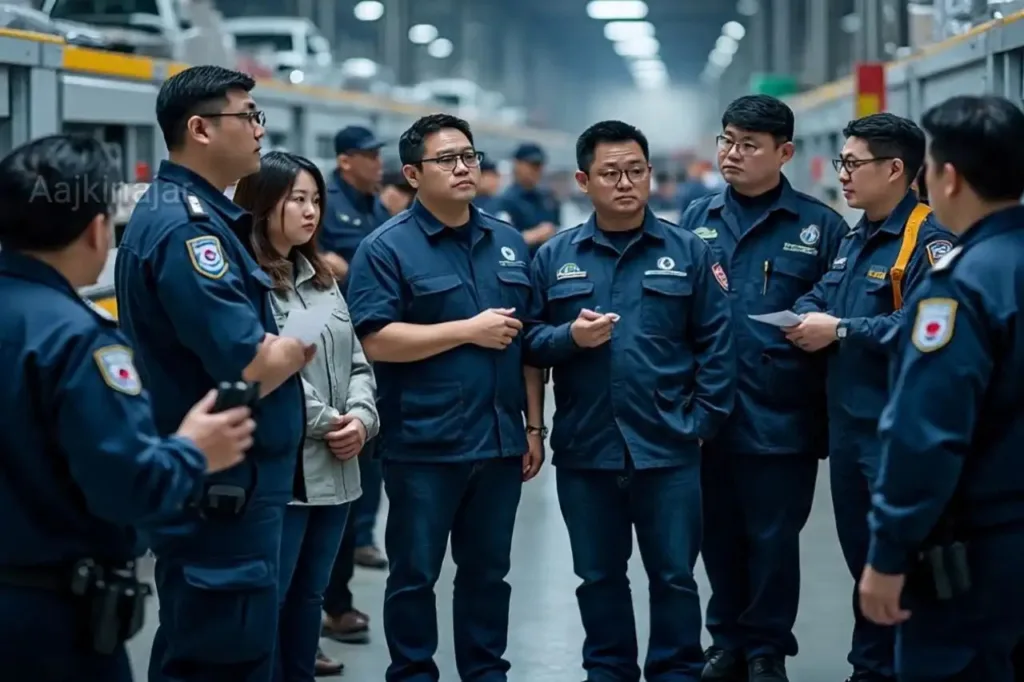
The Department of Homeland Security (DHS) has confirmed that hundreds of workers—many of them South Korean nationals—were detained at the Georgia Hyundai plant construction site during what officials are calling the largest single-site immigration enforcement action in U.S. history. This sweeping raid, which took place at the Hyundai–LG Energy Solution battery facility under development in Ellabell, Georgia, has drawn international attention, raising questions about immigration policy, corporate accountability, and the future of U.S.–South Korea economic ties.
The Raid: Largest Enforcement Action in DHS History
According to DHS, more than 475 workers were detained at the sprawling Hyundai–LGES site. The raid followed a months-long investigation into reports of unauthorized foreign workers being employed at the project through third-party contractors and subcontractors.
Officials said the raid was executed under a judicial warrant and involved multiple agencies, including Immigration and Customs Enforcement (ICE), Homeland Security Investigations (HSI), the FBI, DEA, and ATF. The unprecedented scale underscores the Biden-to-Trump era policy shift back toward stricter enforcement against undocumented labor in major industries.
Authorities reported that most of those detained were South Korean nationals who had allegedly overstayed temporary visas or entered the U.S. under visa waiver programs not permitting employment.
Hyundai and LG Energy Solution’s Response
In a joint statement, Hyundai Motor Group and LG Energy Solution emphasized that the detained workers were not direct employees of the companies but were instead linked to subcontractors. The companies pledged full cooperation with federal investigators and temporarily suspended portions of the construction project.
The Georgia facility, part of Hyundai’s $12.6 billion investment in U.S. electric vehicle (EV) production, has been touted as one of the largest job-creating projects in the Southeast. The raid has now cast uncertainty over construction timelines and raised concerns among local workers and officials.
South Korea’s Government Reacts
The news sparked immediate concern in Seoul, where government officials expressed “deep regret” and called for the protection of the rights and welfare of South Korean nationals affected by the raid.
The South Korean Embassy in Washington, D.C., and the Consulate General in Atlanta dispatched teams to Georgia to provide assistance to detainees, ensure fair treatment, and begin discussions with U.S. authorities.
For South Korea, the incident touches not just on labor rights but also on the broader economic partnership with the United States, especially as Korean companies like Hyundai, LG, and Samsung have made multi-billion-dollar commitments to American manufacturing.
Local and Political Reactions in Georgia
In Georgia, reactions to the raid have been mixed. Supporters of stricter immigration policies applauded DHS for holding companies accountable and protecting American jobs. Critics, however, argued that the sudden mass detentions disrupted families, communities, and workers who may have been exploited by contractors rather than willingly violating laws.
Local leaders expressed worry that the raid could damage Georgia’s reputation as a pro-business state and complicate future foreign investments. For residents of Ellabell, a small community banking on the plant for economic revival, the halt in construction is already being felt.
Broader U.S.–South Korea Relations
The detentions come at a delicate moment in U.S.–South Korea relations, where cooperation in trade, defense, and technology has been steadily expanding. Hyundai’s Georgia plant was seen as a landmark project symbolizing bilateral trust.
Experts warn that unless the issue is handled carefully, it could strain diplomatic ties. South Korea’s Foreign Ministry has already urged Washington to ensure transparency and fair legal processes. At the same time, U.S. officials maintain that the raid was about enforcing immigration law, not targeting a specific nationality.
Immigration Policy Under Spotlight
The operation has reignited debate about immigration and labor policy in the U.S. Some argue that large companies rely too heavily on complex subcontracting networks that can obscure accountability and create loopholes for labor violations.
Others see the raid as part of a broader political strategy to demonstrate toughness on immigration, particularly amid an election season where border security and illegal employment are hot-button issues.
Labor rights advocates point out that workers—many of whom are skilled tradespeople brought in for specialized construction tasks—are often victims of a system that prioritizes cost savings over legal compliance.
Economic Stakes: Billions on the Line
The Hyundai–LGES project represents one of the largest foreign investments in Georgia’s history. Once complete, the battery plant is expected to employ thousands of American workers and supply EV batteries across North America.
With construction now delayed, questions remain about whether Hyundai can meet its ambitious production timelines. Analysts note that uncertainty surrounding foreign labor could ripple across the EV supply chain, especially at a time when the U.S. is racing to compete with China in clean energy manufacturing.
Historical Context: Immigration Raids and Industry
Immigration raids of this scale are rare but not unprecedented. Past operations have targeted meatpacking plants, farms, and factories accused of hiring undocumented workers. However, the Hyundai raid marks the first time such an action has struck at the heart of the emerging EV industry, signaling a tougher stance toward high-profile global corporations.
For Hyundai and LGES, the fallout could reshape how they manage workforce oversight and subcontractor accountability in the U.S. moving forward.
What Happens Next?
DHS has said that detainees will undergo individual case reviews to determine legal outcomes—ranging from deportation proceedings to possible legal adjustments depending on circumstances. Hyundai and LGES, meanwhile, will face scrutiny over their subcontracting practices.
In the coming weeks, both U.S. and South Korean officials are expected to continue talks, balancing enforcement of immigration law with the need to protect vital economic partnerships.
For now, the story of South Korean nationals detained at the Georgia Hyundai plant stands as a flashpoint in the ongoing intersection of immigration enforcement, corporate responsibility, and international diplomacy.
FAQs on South Korean Nationals Detained at Georgia Hyundai Plant
Q1. Why were South Korean nationals detained at the Georgia Hyundai plant?
They were detained during a DHS raid for alleged visa violations and unauthorized employment at the Hyundai–LG Energy Solution construction site.
Q2. How many workers were detained in the raid?
More than 475 workers were detained, making it the largest single-site immigration enforcement action in U.S. history.
Q3. Were the detained workers direct employees of Hyundai?
No, Hyundai and LGES stated that the detained workers were hired through subcontractors, not as direct employees.
Q4. What is the Hyundai Georgia plant project?
It is a massive electric vehicle (EV) battery facility under construction in Ellabell, Georgia, part of Hyundai’s $12.6 billion U.S. investment.
Q5. What was the U.S. government’s reason for the raid?
DHS cited a months-long investigation into unauthorized employment and violations of U.S. immigration law.
Q6. How has the South Korean government responded?
Seoul expressed concern and dispatched diplomats to Georgia to ensure the protection of its nationals’ rights.
Q7. What impact will this raid have on the Hyundai project?
Construction has been paused, raising uncertainty about project timelines and the broader EV supply chain.
Q8. How has the local Georgia community reacted?
Reactions are mixed—some support stricter immigration enforcement, while others worry about job delays and the impact on Georgia’s pro-business reputation.
Q9. Could the raid affect U.S.–South Korea relations?
Yes, experts warn it could strain ties unless handled with transparency and diplomacy, given South Korea’s major investments in the U.S.
Q10. What happens to the detained workers now?
Each detainee will undergo individual case reviews to determine whether they face deportation or other legal processes.
Q11. Has Hyundai faced similar issues before in the U.S.?
No, this is the first large-scale immigration enforcement action tied to Hyundai’s U.S. operations.
Q12. What are the long-term implications for foreign companies investing in America?
The raid may push companies to strengthen compliance and oversight of subcontractors to avoid legal and reputational risks.
Read More :-Brazil vs Chile: A South American Football Rivalry