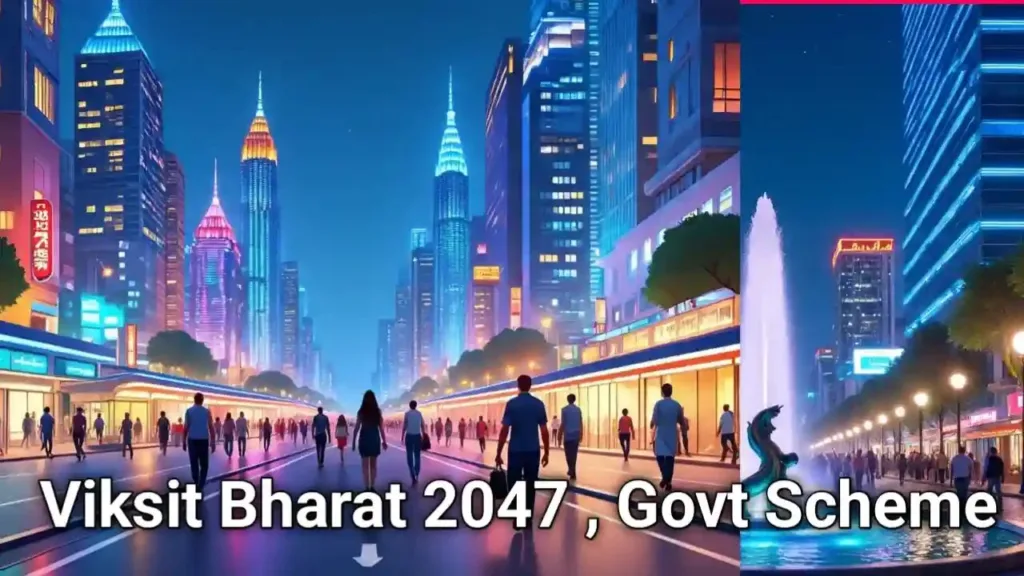
Introduction: What is Viksit Bharat?
“Viksit Bharat” is more than just a slogan – it is India’s long-term vision to become a fully developed nation by the year 2047, coinciding with the 100th year of independence. The Government of India has launched several visionary programs under the Viksit Bharat roadmap, focusing on economic growth, social equity, sustainable development, digital transformation, and global leadership.
In 2025, new government schemes and initiatives were introduced as part of the Viksit Bharat 2047 Vision Schemes, with the goal of building a self-reliant, inclusive, and globally competitive India. This article explores the complete roadmap of Viksit Bharat, its objectives, schemes, and the way forward.
The Core Idea of Viksit Bharat
The Viksit Bharat vision revolves around creating a developed economy that ensures prosperity for every citizen. Unlike traditional development plans, Viksit Bharat integrates economic, environmental, social, and technological progress to build a balanced future.
The government has identified five pillars of Viksit Bharat:
- Strong Economy – Transforming India into a $30–$35 trillion economy by 2047.
- Social Equality – Bridging the gap between rich and poor, urban and rural.
- World-Class Infrastructure – Roads, railways, airports, renewable energy, and digital infrastructure.
- Global Leadership – Making India a leader in diplomacy, technology, and innovation.
- Sustainable Growth – Protecting the environment while pursuing industrialization.
Viksit Bharat 2047 Vision Schemes Launched in 2025
1. PM Surya Ghar Muft Bijli Yojana
As part of Viksit Bharat, the government launched the PM Surya Ghar Muft Bijli Yojana in 2025. This scheme promotes solar rooftop installations, providing free electricity (up to 300 units per month) for households. It aims to reduce dependence on fossil fuels and cut electricity bills while making India a green energy leader.
2. Digital India Expansion 2.0
To accelerate Digital Viksit Bharat, the government announced the expansion of the Digital India Mission with AI-driven governance, smart cities, e-healthcare, and digital education platforms. By 2047, India aims to have a 100% digitally connected economy.
3. Skill India Vision 2047
Creating a future-ready workforce is central to Viksit Bharat. Under this scheme, vocational training, AI, robotics, green energy, and advanced manufacturing skills are being prioritized to prepare youth for the jobs of the future.
4. Infrastructure Push – Gati Shakti 2.0
The PM Gati Shakti National Master Plan is being expanded to include high-speed railways, mega highways, smart ports, green airports, and logistics hubs. This is key to making Viksit Bharat globally competitive.
5. Green Hydrogen Mission
The National Green Hydrogen Mission supports India’s energy transition, aiming to make India a global hub of green hydrogen production by 2030 – a vital step in the Viksit Bharat climate roadmap.
6. Affordable Housing – Gramin Awas Yojana 2047
Affordable housing for all is a cornerstone of Viksit Bharat. The 2025 expansion of rural housing schemes aims to provide every Indian family a pucca house by 2047.
7. Education & Research Excellence Program
Under the Viksit Bharat education vision, new research universities, AI labs, and innovation centers are being established to make India a hub of knowledge economy.
Why Viksit Bharat is Important
- Economic Prosperity – India will move from a developing to a developed economy.
- Social Justice – Inclusive growth ensures that no citizen is left behind.
- Energy Security – Renewable energy schemes will reduce imports.
- Employment Generation – Skilling and industrial growth will create millions of jobs.
- Global Influence – India will emerge as a strong voice in world affairs.
Challenges in Achieving Viksit Bharat
While the Viksit Bharat roadmap is ambitious, challenges exist:
- Ensuring financial resources for large-scale infrastructure.
- Tackling climate change while industrializing.
- Bridging the urban-rural digital divide.
- Creating jobs fast enough for India’s youth population.
- Maintaining political and policy continuity till 2047.
Government’s Roadmap Towards Viksit Bharat
The government has divided the Viksit Bharat roadmap into phases:
- 2025–2030 – Infrastructure expansion, green energy push, and digital connectivity.
- 2030–2035 – Mass employment creation, skill development, and global investments.
- 2035–2040 – Leadership in technology, space, AI, and clean energy.
- 2040–2047 – India as a developed, sustainable, and inclusive global superpower.
Public Participation in Viksit Bharat
The success of Viksit Bharat depends not only on the government but also on citizen involvement. Programs like Meri Maati Mera Desh, Amrit Kaal roadmap consultations, and public feedback portals are encouraging people to contribute ideas to shape the Viksit Bharat 2047 vision.
Conclusion: A Developed India by 2047
The dream of Viksit Bharat is not just a government vision – it is a national mission. By combining policy reforms, digital revolution, green energy, infrastructure growth, and citizen participation, India is moving steadily towards becoming a developed nation by 2047.
If implemented effectively, Viksit Bharat 2047 will transform India into a self-reliant, equitable, and globally respected superpower.
✅ 15 Best & Searchable FAQs with Answers
1. What is Viksit Bharat 2047 Vision?
The Viksit Bharat 2047 Vision is the Government of India’s long-term roadmap to transform India into a developed nation by 2047, focusing on infrastructure, economy, education, healthcare, and technology.
2. Who launched Viksit Bharat 2047?
Prime Minister Narendra Modi launched the Viksit Bharat 2047 Vision, emphasizing India’s growth path towards becoming a global leader.
3. What are the key objectives of Viksit Bharat?
The main objectives include poverty eradication, digital innovation, sustainable development, world-class infrastructure, women empowerment, and global competitiveness.
4. Which government schemes are part of Viksit Bharat 2047?
Schemes like PM Gati Shakti, Digital India Mission, PM Kisan, National Green Hydrogen Mission, and skill development programs are part of Viksit Bharat.
5. How will Viksit Bharat impact common citizens?
It will provide better education, healthcare, housing, jobs, clean energy, digital access, and improved quality of life for every citizen.
6. What is the role of technology in Viksit Bharat 2047?
Technology plays a crucial role through AI, renewable energy, smart cities, digital governance, and advanced healthcare systems.
7. Is Viksit Bharat only an economic vision?
No, it is a holistic vision that covers social, cultural, environmental, and economic development for inclusive growth.
8. How is Viksit Bharat linked to India’s independence centenary?
By 2047, when India completes 100 years of independence, the government aims to position the country as a fully developed nation.
9. What role do youth play in Viksit Bharat?
Youth will drive innovation, entrepreneurship, skill development, and technological advancement under various government programs.
10. Does Viksit Bharat focus on renewable energy?
Yes, renewable energy initiatives like solar rooftops, wind energy, and the Green Hydrogen Mission are core parts of the plan.
11. Will Viksit Bharat create new jobs?
Yes, through industrial growth, skill training, digital startups, and infrastructure projects, millions of jobs are expected to be created.
12. How does Viksit Bharat 2047 support rural India?
It focuses on rural electrification, housing, water supply, agriculture modernization, and digital connectivity in villages.
13. Is Viksit Bharat connected to Make in India?
Yes, Make in India complements Viksit Bharat by boosting manufacturing, exports, and self-reliance in production.
14. What is the timeline for Viksit Bharat goals?
The roadmap covers short-term (2025), mid-term (2030), and long-term (2047) milestones for development.
15. How can citizens contribute to Viksit Bharat Vision?
Citizens can contribute by adopting digital platforms, supporting renewable energy, skill development, entrepreneurship, and active participation in government initiatives.
Read More:- Senior Citizen Savings Scheme (SCSS) 2025: A Safe Investment for Retirement Planning